
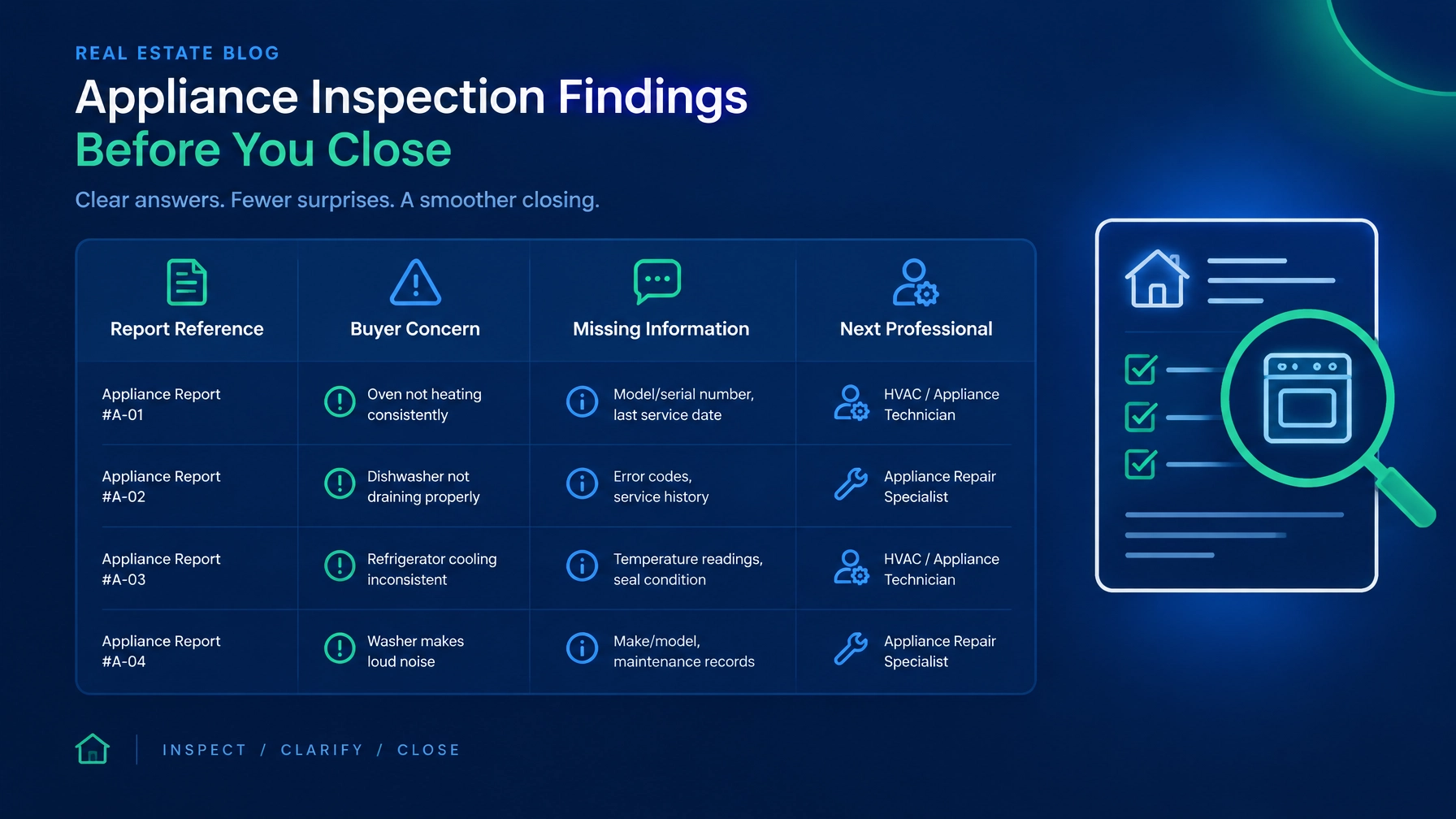
When a buyer asks about appliances before a holiday closing, the REALTOR should begin with the inspection finding and the inspector's stated limitations. Clarify the buyer's concern, identify any professional evaluation still needed, and explain the available response paths without promising future appliance performance.
Key takeaways
- Start with what the report says, when the inspection took place, and what its scope included.
- Keep appliance age separate from an observed malfunction or a recommendation for further evaluation.
- Direct technical questions to an appropriate professional; do not diagnose or promise future performance.
- Organize report references and buyer priorities before discussing transaction response options.
How should you start with the reported condition and your buyer’s question?
Separate the buyer’s intended use from the condition the inspector documented. Before a holiday closing, your buyer may be thinking about a specific need, such as whether an oven will work for a planned holiday meal. That concern matters to the conversation, but it does not establish what the appliance can do or whether it will continue to operate.
Illustrative scenario: Your buyer sees a note about an oven and asks whether it will handle a holiday meal. Begin by locating the exact report entry. Does it describe a function that was tested, an observed issue, an age comment, or a recommendation for further evaluation? Next, clarify what the buyer is asking: Are they concerned about the report’s finding, the appliance’s present operation, or relying on it for a particular use after closing? Keep those questions distinct. Explain that the report records the inspector’s observations within the applicable scope on the inspection date. If the buyer needs current technical confirmation, identify an appropriate professional to ask. Then review the buyer’s priorities and transaction context before discussing whether any response is appropriate. The report does not guarantee performance at closing or during a holiday meal.
This approach acknowledges your buyer’s practical concern without turning it into a technical conclusion. For more context on appliance issues found during a home inspection, preserve the distinction between the report’s wording and any later professional assessment.
What did the inspection establish, and what did it not?
The inspection report is a dated record of observations made within its stated scope, not a promise about future operation. Review the report entry alongside the inspection date, the applicable inspection agreement or scope, the functions reportedly tested, and any access or testing limitations noted.
Do not assume every appliance, setting, or mode was tested. ASHI’s guidance on inspection scope explains why scope provisions and testing methods matter. It is ASHI guidance, not proof that every inspector follows ASHI standards or examines appliances in the same way. Check the relevant report and scope documents for the inspection at hand.
A useful explanation to your buyer is: “Let’s confirm exactly what the report says was observed and what the inspector’s scope included. If you need a current technical assessment, we can identify the appropriate professional to contact.”
That wording keeps the source visible and avoids expanding a limited observation into a diagnosis. It also helps prevent a buyer’s understandable concern from being mistaken for evidence of a specific defect. The inspector or another qualified professional should answer technical questions within their role.
How should you separate an age note from a documented problem?
An age reference and an observed malfunction are different kinds of information. Neither should be stretched into a conclusion the report does not support.
Service-life comments
An age comment may provide context for planning. On its own, it does not establish that an appliance is malfunctioning, must be replaced, or will fail by a particular date. InterNACHI’s limitations guidance describes the general limits of a home inspection; its Standards of Practice also distinguish an appliance’s age from a material defect. Confirm which inspection standard applies to the report you are discussing.
If replacement planning comes up, keep age and observed condition distinct. PropWise’s guide to repair versus replacement after inspection offers further discussion without making age alone a replacement rule.
Observed malfunction
A report may describe a specific condition, such as a function that did not operate during the inspection. Repeat the wording accurately. Do not infer the cause, repair method, or full extent of the issue unless a qualified professional has assessed it.
Further evaluation
If the report recommends evaluation or leaves an important question open, identify the appropriate professional and whether that person is available within the transaction timeline. Your role is to organize the follow-up, not to perform the technical assessment.
Which follow-up questions should you ask?
Good questions connect the source finding to the buyer’s concern and the right professional. Use the report reference as the starting point, then list what remains unknown before deciding whether follow-up is useful.
| Report reference | Buyer concern | Missing information | Appropriate professional |
|---|---|---|---|
| Page and exact wording of the appliance finding | What function did not operate, or what condition was observed? | Which functions were tested, under what conditions, and were any limitations noted? | The inspector for report-scope clarification; an appropriate appliance professional for current technical evaluation |
| Page with an age or service-life comment | Does age alone mean the appliance needs replacement? | Are there service records? Is a specific malfunction documented? | An appliance professional for condition questions |
| Report note about a function or operation | Can the appliance perform the buyer’s intended normal use? | What does normal operation involve for this model, and can an evaluator assess it before the relevant transaction deadline? | A qualified appliance professional |
| Report reference with an unresolved question | Can the buyer obtain an evaluation before making a decision? | Is an appropriate evaluator available, and what information or access do they need? | The relevant appliance or trade professional |
Where appropriate, ask whether service records are available, what “normal operation” means for the question at hand, and whether an evaluator can assess the appliance within the buyer’s timeline. Do not suggest a test or repair procedure yourself. A professional should determine what evaluation is suitable.
PropWise can help REALTORS organize documented findings by category and review cost context when available. Keep the original inspection report visible as the source, and check organized findings against it. See how PropWise works.
What response options can you discuss with your buyer?
The conversation should reflect the documented finding, any professional follow-up, the buyer’s priorities, and the transaction context. Not every appliance comment requires a seller repair request. A buyer may decide that a finding warrants further evaluation, may want to discuss a response, or may be comfortable proceeding without a request.
Avoid recommending a particular outcome based only on appliance age or a concern about holiday use. Instead, help your buyer distinguish what is documented from what remains unknown, then discuss the options available under the transaction’s applicable terms and timelines. Contract interpretation and legal questions belong with the appropriate legal professional; transaction decisions should also follow brokerage guidance.
For a fuller discussion of possible response paths, review repair, credit, price reduction, or accepting as-is. The goal is not to copy a framework into every appliance discussion. It is to help your buyer compare options with the relevant facts in view.
How can you organize appliance findings before the conversation?
A short, source-linked review can make a long report easier to discuss without replacing professional judgment. For each appliance item, keep the report reference, exact finding, inspection date, stated limitation, buyer question, missing information, and possible professional follow-up together. This structure can reduce cognitive overload while preserving the difference between an inspector’s observation and a later evaluation.
When cost context is available, treat it as informational context, not a binding contractor quote, diagnosis, or guarantee. A qualified professional should assess the appliance and provide any scope or estimate needed for a specific decision.
REALTORS: Bring more structure to appliance questions and the rest of the inspection report. Create your free PropWise account and explore the report-review training.
What questions do REALTORS often ask?
Does an older appliance automatically belong in a replacement request?
No. Age, observed condition, buyer priorities, and transaction context are separate considerations. An age comment alone does not establish a malfunction or a guaranteed need for replacement. Start with the report language and any relevant service records, then help your buyer decide whether further professional evaluation or a transaction response merits discussion.
Can I tell my buyer the inspection guarantees holiday performance?
No. Explain that the report records observations made within its applicable scope on the inspection date; it does not guarantee future appliance performance. If your buyer needs a current technical answer about operation or intended use, direct the question to an appropriate professional. Avoid making your own diagnosis or promising an outcome.
How should I organize several appliance questions?
Group each question with its report reference, stated finding, buyer concern, missing information, and appropriate next professional. Keep the original report available for comparison. PropWise can help organize inspection findings and provide cost context when available, but it does not replace the report, a qualified professional’s evaluation, or your REALTOR judgment.